
English| EUR
Suggested for you
More currencies
Choose a language
Everything diveable on Aruba lines up along one sheltered coast, which makes planning simpler than on most Caribbean islands. This Aruba scuba diving sites guide explains how the wrecks, reefs and walk-in entries are distributed, and what separates one from another. Access rules, conditions and the practical limits of each type are set out below.
Quick answer
Aruba's dive sites cluster along the sheltered leeward coast, from Arashi and Malmok in the northwest down to Baby Beach in the southeast, and public access costs 0 USD, with fees applying only to operator tours. Beaches and dive sites are accessible 00:00–23:59 every day. Conditions favour an 08:00–11:00 arrival, since afternoon trade winds roughen the surface.
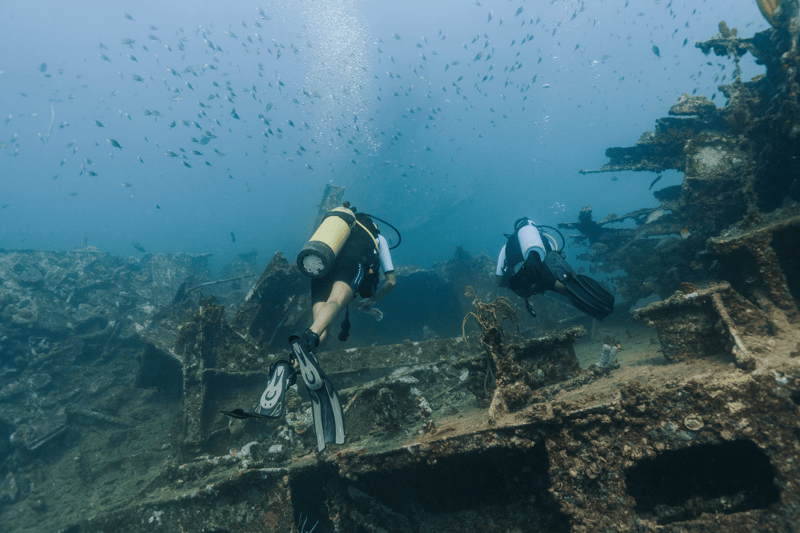
The Antilla, a 120-metre German freighter scuttled by her own crew off Malmok in May 1940, still lies on her port side in roughly 18 metres of water, shallow enough that parts of the superstructure catch daylight. She is among the largest wrecks in the Caribbean, and she explains why Aruba scuba diving sites draw divers who might otherwise book Bonaire or Curaçao. The island's underwater inventory is unusually compressed: almost all of it sits along a 25-kilometre strip of leeward coast between Arashi in the northwest and Baby Beach in the southeast. That compression is a function of wind. The trade winds blow almost constantly from the east, so the windward shore stays churned while the western and southwestern coast holds flat water and visibility that commonly runs 18 to 30 metres. Dive operators sort the leeward options into three broad families. Wrecks come first: the Antilla, the torpedoed tanker Pedernales off Palm Beach, the Jane Sea near Barcadera, and the Debbie II, sunk deliberately in 1992. Reefs form the second group, from Barcadera Reef to the sloping coral terraces off Kantil and Plonco. Shore diving in Aruba makes up the third, with entries at Mangel Halto, Boca Catalina, Tres Trapi and Malmok that need no boat at all. Depths range from three metres to beyond thirty, which is why experience level matters more here than any map. Reading a list of Aruba dive sites is therefore only half the task; the useful move is to match a site to a certification and a comfort level. Open-water divers manage the Antilla's upper decks and most reef drifts without difficulty. Interior penetration, the deeper southern wrecks and any current-swept profile belong to advanced divers with a guide. Shore entries look easy on paper but involve surface swims, rocky footing and, at Mangel Halto, a channel through mangroves. Nearly every operator works the same window, running two-tank morning trips from the marinas at Oranjestad and Palm Beach, which means boat space on the headline Aruba scuba diving sites thins quickly in high season. Checking availability and reserving a slot before arriving on the island is the single practical step that keeps the plan intact.
“Almost everything diveable on the island sits along a 25-kilometre strip of leeward coast, which is why experience level matters more here than any map.”
Aruba offers consistent diving conditions year-round, though the best arrival window for optimal lighting and calm sea conditions is 08:00–11:00. Visiting between April and November often provides the calmest water visibility for exploring coastal sites.
—
The best arrival window is 08:00–11:00 to ensure calm sea conditions for boat and shore dives.
Warm, 80-85°F (27-29°C)
These months typically feature lighter winds and clearer underwater visibility.
Mild, 78-82°F (25-28°C)
Trade winds are stronger during this period, which can occasionally impact surface conditions for some coastal sites.
Verdict: The most effective planning strategy involves scheduling dives between 08:00–11:00 during the months of April or October.
Access to all public scuba diving sites in Aruba is free of charge. Costs for diving are associated exclusively with professional services provided by licensed operators.
Verdict: Divers pay 0 USD for site access, while total costs depend on the specific services and boat charters booked through licensed operators.
Aruba's coastal scuba diving sites are accessible to the public at all hours throughout the week.
Aruba scuba diving sites are located at various coastal positions around the island. Most divers reach these locations via boat charters departing from major harbors or by private vehicle to access shore dive entry points.
Route 1 or Route 1B to coastal beach parking areas
Charter departure from Oranjestad or Palm Beach marinas
Direct service to designated beach entry points
For shore dives, arrive between 08:00–11:00 to ensure optimal parking availability and calm sea conditions. Coordinate with your selected dive operator for specific meeting points if traveling by boat.
Gather these essentials to meet operator requirements and dive safely around Aruba's coastal sites.
Everything you need to know about aruba scuba diving sites
There is a 0 USD entrance fee for all public beaches and dive sites. Please note that separate fees apply if you choose to book tours through a professional operator.
The best arrival window is between 08:00 and 11:00. This period offers optimal lighting and calm sea conditions for both boat and shore dives.
While you can access the coastline, it is recommended to join a professional tour to safely navigate aruba scuba diving sites. Operators provide necessary logistics and safety support for a better experience.
Age requirements vary by operator and certification level. Most local dive shops follow international standards, so inquire directly with a provider regarding specific youth programs.
Divers typically require standard equipment including a mask, fins, regulator, and buoyancy control device. Most operators renting gear at these aruba scuba diving sites provide high-quality, maintained equipment for your dive.
Yes, most reputable operators require proof of certification for open water dives. If you are not certified, you may look for introductory discover scuba programs offered by local dive centers.
Divers often encounter sea turtles, stingrays, and various tropical fish within the coral reefs. Exploring these aruba scuba diving sites also provides opportunities to see historic shipwrecks and sponge formations.
Scuba Diving for Beginners
Read more GuideScuba Diving Prices & Packages
Read more Tickets & toursScuba Diving for Non-Certified Divers
Read more Tickets & toursCruise Ship Shore Diving
Read more Tickets & toursPrivate Scuba Diving Tours
Read more Tickets & toursPADI Scuba Certification
Read more Tickets & toursAntilla Shipwreck Dives
Read more